Restorative Dentistry · Missing Tooth Replacement
A dental bridge replaces a missing tooth permanently, restores your bite and appearance, and prevents surrounding teeth from shifting, in just two appointments.
What a dental bridge is
A dental bridge consists of two crowns (on the adjacent teeth) and one or more artificial teeth, called pontics, suspended between them. The entire unit is cemented permanently, functioning exactly like your natural teeth.
Unlike a removable partial denture, a bridge is fixed in place. You eat, speak, and clean your teeth normally, no removal, no adhesive, no visible hardware.
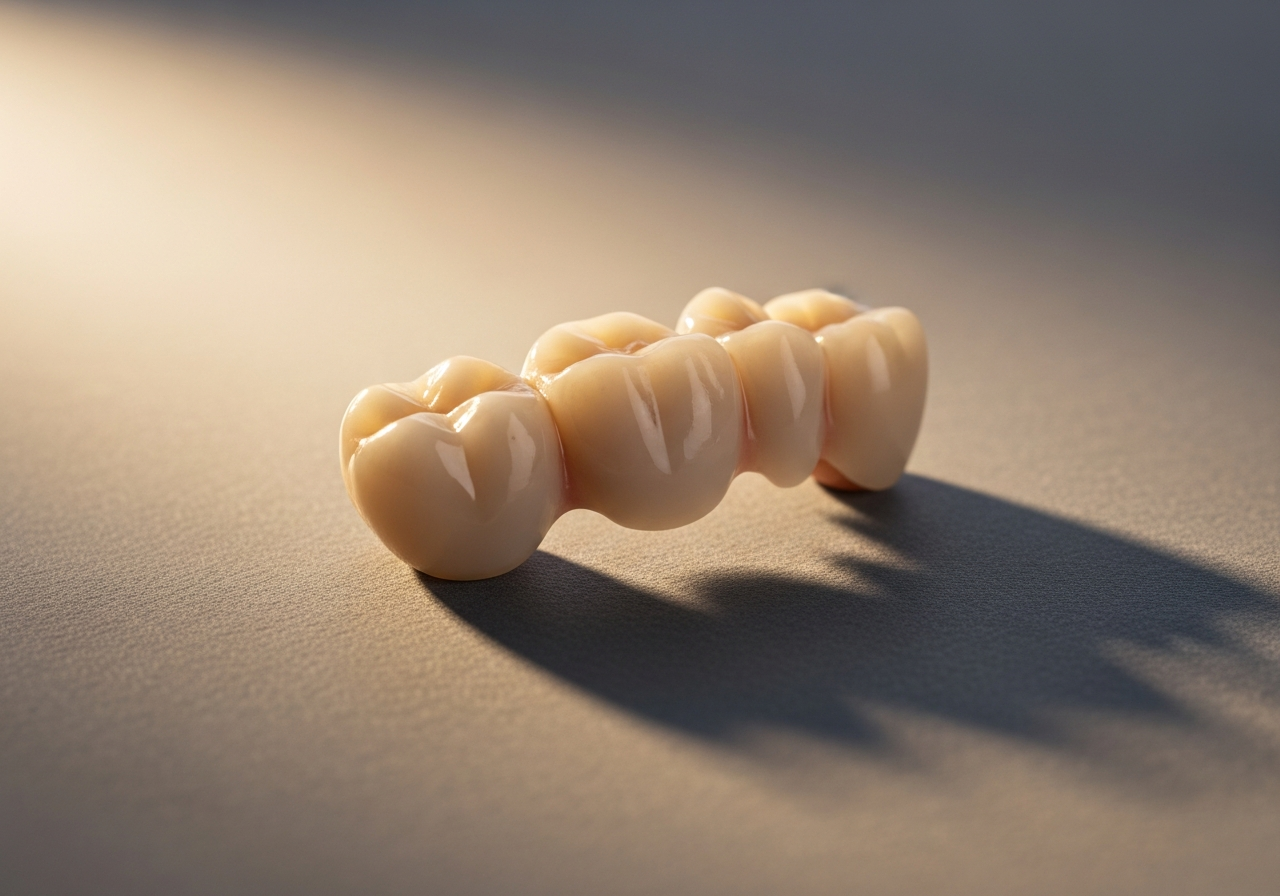
Types of bridges
Best for: One missing tooth with healthy teeth on both sides
The two teeth adjacent to the gap (abutment teeth) are crowned, and a porcelain pontic suspends between them. The most common bridge type, durable, aesthetic, and non-surgical.
Best for: Multiple missing teeth in a row
Instead of using natural teeth as anchors, two or more implants support a multi-unit bridge. Preserves bone, doesn't require altering natural teeth, and provides maximum longevity.
Best for: Front tooth replacement when abutments are intact and healthy
Metal or porcelain wings bond to the back of adjacent teeth, supporting the pontic without crowning the abutments. More conservative but less durable for high-force areas.
Best for: When only one healthy abutment tooth is available
The pontic is supported by a crown on only one adjacent tooth. Less common due to increased stress on the anchor tooth; typically used for lower-force areas.
The procedure
We evaluate the gap, the health of adjacent teeth, and the bone beneath the space. If those teeth are compromised, an implant may be recommended instead.
The two teeth on either side of the gap are shaped (reduced) to receive crowns. Local anesthesia ensures comfort throughout.
Precise impressions go to the lab. A temporary bridge protects the prepared teeth and maintains the gap width during fabrication, typically 2–3 weeks.
At your second appointment, the temporary is removed, the permanent bridge is tried in, adjusted for fit and bite, and cemented permanently. The restoration is immediately functional.
Bridge vs. implant
| Factor | Dental Bridge | Dental Implant |
|---|---|---|
| Surgery required | No, a non-surgical procedure | Yes, titanium post placed in bone |
| Treatment time | 2–3 weeks (two appointments) | 3–6 months (surgery through crown) |
| Bone preservation | No, bone under the gap resorbs over time | Yes, implant stimulates bone like a natural root |
| Effect on adjacent teeth | Adjacent teeth must be crowned | Adjacent teeth are untouched |
| Longevity | 10–15 years with proper care | 20–30+ years; implant often lifetime |
| Cost (upfront) | Lower initial investment | Higher, though often better long-term value |
Bridge care
Floss under the bridge daily using a floss threader or water flosser
Brush normally, pay extra attention to the margins where crowns meet the gumline
Avoid chewing hard foods (ice, hard candy) directly on the bridge
Schedule regular cleanings, your hygienist has special tools to clean around bridges
Wear a night guard if you grind, grinding dramatically shortens bridge lifespan
Common questions
A well-maintained porcelain bridge typically lasts 10–15 years. The most common reasons for replacement are new decay at the crown margins or failure of the cement bond, both preventable with good hygiene and regular checkups.
Yes. Once the cement fully sets (24 hours), a bridge functions like natural teeth. The only restriction is to avoid using the bridge to crack or bite very hard foods, which can fracture the porcelain.
Custom porcelain bridges are shade-matched to your surrounding teeth in color, translucency, and surface texture. When done well, they're difficult to distinguish from natural teeth.
Because no root is present under the pontic, the underlying bone gradually resorbs over time. This rarely causes functional problems for a bridge, but is one of the reasons an implant is often preferred if you're a candidate, implants preserve bone.
Both are excellent options. A bridge is faster, less expensive upfront, and non-surgical. An implant is more conservative to adjacent teeth, preserves bone, and typically lasts longer. We'll walk you through both at your consultation and give you an honest recommendation.
Service area
Replace the missing tooth
Call our Turkey Lake Road office. We'll evaluate the gap, show you your options, and give you a clear path to a fully restored bite.