General Dentistry · Preventive Care
Routine exams and cleanings find problems before they become painful and expensive, protecting your teeth, your wallet, and your overall health.
47%
of American adults have gum disease, most don't know it
6 months
is how long tartar needs to calcify below the gumline before it begins damaging bone
3–4×
higher likelihood of tooth loss in patients who skip routine care
Early detection
turns a $200 filling into a $2,000 crown when delayed
What your exam covers
Our thorough exams cover six distinct areas, giving you a complete picture of your oral health at every visit.
Every tooth surface is examined for decay, fractures, wear patterns, and changes since your last visit.
Bitewing and, when indicated, panoramic X-rays detect cavities between teeth, bone loss, and pathology invisible to the naked eye, with 80% less radiation than traditional film.
We measure pocket depths around every tooth, check for bone loss, and chart bleeding points, the data that tracks your gum health over time.
A systematic visual and tactile check of the lips, tongue, cheeks, palate, and throat takes under two minutes and catches tissue changes when they're most treatable.
We check your jaw joint for clicking, tenderness, and range of motion, and evaluate your bite for signs of grinding or alignment concerns.
Crowns, fillings, veneers, bridges, and implants are checked for wear, margin integrity, and signs of failure, catching issues before they become emergencies.
Professional cleaning
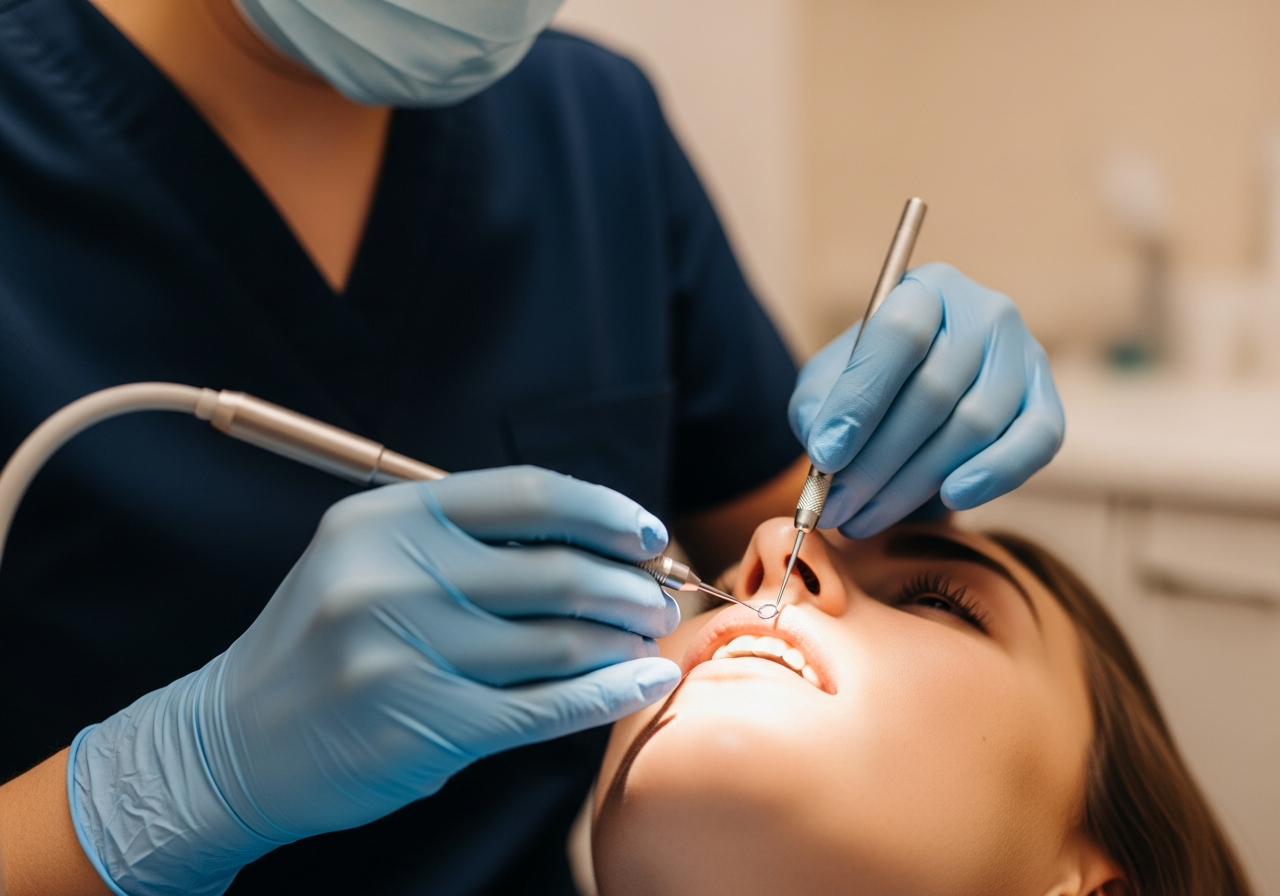
No matter how diligent your brushing and flossing, plaque hardens into calculus (tartar) in areas your brush can't fully reach, especially below the gumline. Only professional instruments remove it safely.
Ultrasonic scaling to remove hardened calculus (tartar) from above and below the gumline
Hand scaling to clear residual deposits in tight spaces and around the gumline
Polishing to remove surface stains and smooth enamel, making it harder for plaque to adhere
Flossing every contact point to remove interproximal buildup
Fluoride treatment to remineralize enamel and reduce sensitivity (where indicated)
What happens at your visit
At your first visit (and updated at each recall), we review medications, systemic conditions, and any changes since your last exam, many of which directly affect your oral health.
Bitewing X-rays are taken at most recall visits (frequency depends on your cavity risk). Panoramic X-rays are taken periodically to evaluate the jaw, sinuses, and bone level.
Your dentist systematically examines every tooth, the gums, soft tissue, bite, and existing restorations. Any findings are documented, discussed with you, and added to your treatment plan.
Your hygienist removes calculus and plaque from surfaces your toothbrush can't reach, especially below the gumline, then polishes and flosses. A fluoride treatment is applied when indicated.
We review findings together, prioritize any recommended treatment, and give you specific guidance for your home care, including brushing technique, floss recommendations, and any products that may benefit your specific situation.
"Preventive dentistry isn't about coming every six months because you're supposed to. It's about keeping you out of the chair for anything more serious."
Venetian Pointe Dentistry. Orlando, FL since 1987
Common questions
Most patients benefit from professional cleaning every 6 months. Patients with a history of gum disease, active decay, or compromised immune function are often scheduled every 3–4 months. We individualize this recommendation based on your actual risk, not a one-size-fits-all protocol.
Most dental problems, cavities, gum disease, early fractures, and even oral cancer, cause no pain in their early stages. Pain is a late symptom that typically signals a much more expensive and invasive treatment. Routine exams catch problems when they're small, painless, and inexpensive to address.
A routine cleaning (prophylaxis) removes plaque and tartar from above and slightly below the gumline in patients with healthy gums. A deep cleaning (scaling and root planing) removes deposits from deeper pockets and root surfaces in patients with gum disease, it's a therapeutic procedure, not just a cleaning.
No. X-ray frequency is based on your individual risk factors. Low-risk adults may only need bitewing X-rays every 18–24 months. Patients with active decay, gum disease, or complex restorations may need them more frequently.
Yes. We see patients of all ages at Venetian Pointe Dentistry. We recommend scheduling a child's first dental visit by age one, or when their first tooth erupts, whichever comes first.
Service area
Schedule your cleaning
Call our Turkey Lake Road office to schedule your exam and cleaning. We're accepting new patients and can typically see you within the week.