Cosmetic Dentistry · Clear Aligner Orthodontics
Invisalign clear aligners shift your teeth gradually and invisibly, with no metal, no food restrictions, and the flexibility to remove them for any occasion.
What Invisalign is
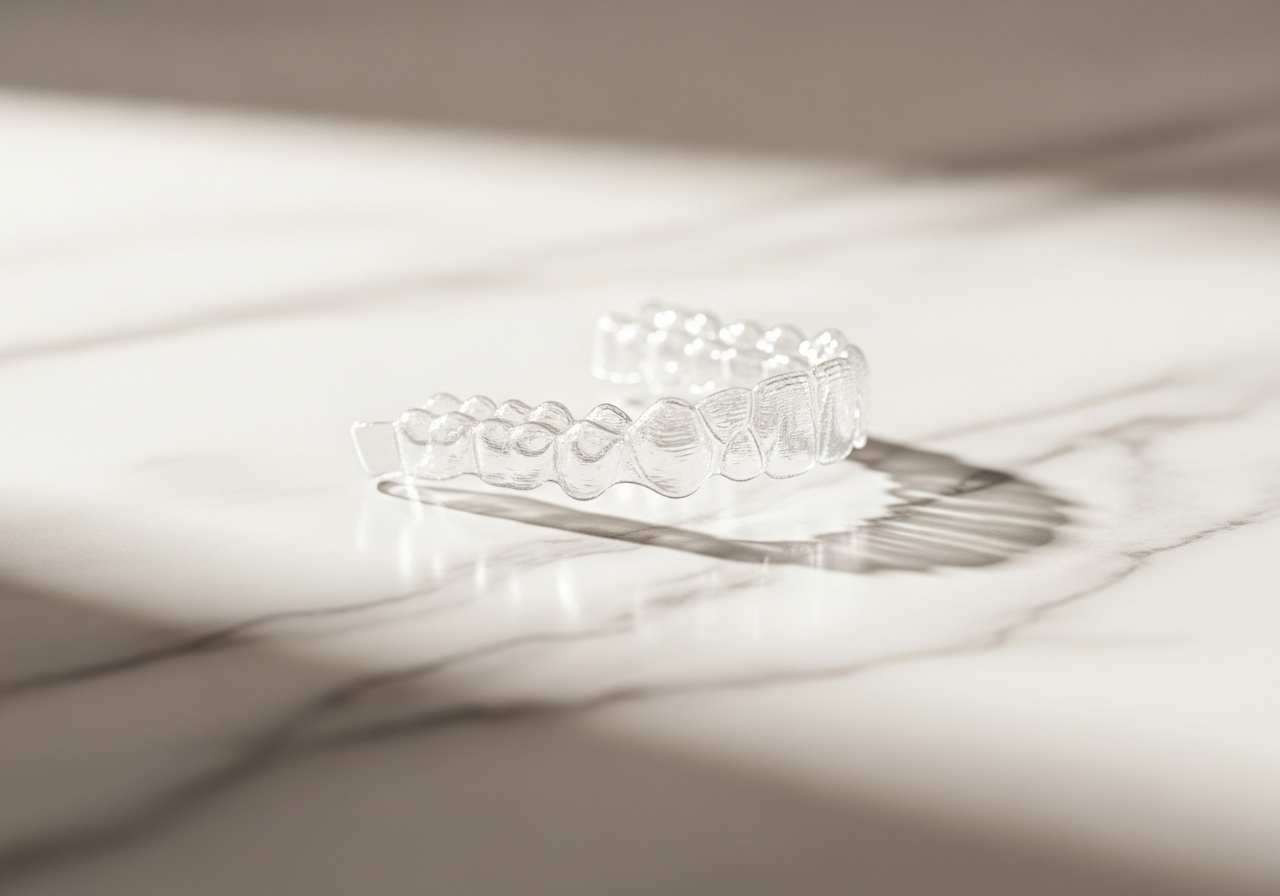
Each set of Invisalign aligners is fabricated specifically for your anatomy using 3D digital scans of your teeth. Rather than pulling teeth with wires and brackets, aligners apply consistent, controlled pressure in precise directions, moving teeth in a sequence mapped by your dentist and Invisalign's proprietary software.
The trays are worn 20–22 hours a day, removed for meals and brushing. Every 1–2 weeks you advance to the next tray, each one slightly different from the last, gradually guiding your teeth into their final position.
What it corrects
Teeth that overlap or are twisted due to insufficient arch space are gradually expanded and aligned.
Gaps between teeth, including diastema between the front teeth, close predictably with aligner therapy.
When the upper front teeth bite too far over the lower, precision attachments and aligner movements correct the depth.
Lower teeth extending forward of the upper teeth respond to Invisalign in mild to moderate cases.
Individual teeth or groups of teeth sitting inside rather than outside the opposing teeth can be corrected with aligner therapy.
Front teeth that don't meet when the back teeth come together require careful planning, aligners address many open bite cases successfully.
From scan to smile
We take precise 3D digital scans of your teeth, no gooey impressions. The Invisalign ClinCheck software maps out every tooth movement from start to finish, and you see a preview of your projected result before committing.
Your unique sequence of aligners is precision-manufactured from medical-grade clear plastic. Each tray is worn for approximately one to two weeks before you advance to the next in the series.
Small tooth-colored dots bonded to specific teeth act as handles, enabling complex movements like rotation and torque. They're virtually invisible and removed at the end of treatment.
We monitor your progress every 6–10 weeks, ensure the teeth are tracking correctly, and make adjustments to the plan if needed. Most corrections can be handled with refinement trays, additional sets fabricated mid-treatment.
Once teeth reach their final position, retainers preserve the result indefinitely. We provide custom retainers and guidelines for wear, the final step that protects your entire investment.
Invisalign vs. traditional braces
| Factor | Invisalign | Traditional Braces |
|---|---|---|
| Visibility | Nearly invisible when worn | Clearly visible metal brackets and wires |
| Comfort | Smooth plastic with no sharp edges | Brackets and wires can irritate cheeks |
| Removability | Removed for eating, brushing, and special occasions | Fixed, cannot be removed |
| Oral hygiene | Normal brushing and flossing | Requires special tools; plaque accumulation higher |
| Food restrictions | None, remove aligners to eat anything | Avoid hard, sticky, and crunchy foods |
| Treatment complexity | Excellent for mild–moderate; advancing with severe | Can handle all complexity levels |
Common questions
Most adult cases complete in 12–18 months. Minor corrections can finish in as little as 6 months. Your ClinCheck simulation will show your estimated timeline before treatment begins.
Invisalign requires 20–22 hours of daily wear for teeth to move on schedule. The flexibility to remove them is an advantage, but treatment only progresses when aligners are in.
Most patients experience some pressure and mild soreness for 1–3 days after advancing to a new aligner set. This indicates the teeth are moving as planned. Over-the-counter pain relievers manage it easily.
Yes. Relapse, teeth shifting back after orthodontic treatment, is extremely common. Invisalign effectively retreats mild to significant relapse cases.
Not every case requires attachments, but many do. We'll show you exactly which teeth will have attachments in your ClinCheck preview. They're small, tooth-colored, and removed without a trace at the end of treatment.
Costs vary with case complexity and treatment length, typically ranging from $3,500 to $7,000. Many dental insurance plans cover a portion. We'll provide a precise quote and financing options at your consultation.
Service area
See your result before you begin
We scan your teeth at your consultation and show you a ClinCheck simulation of your projected outcome, before you commit to a single aligner.